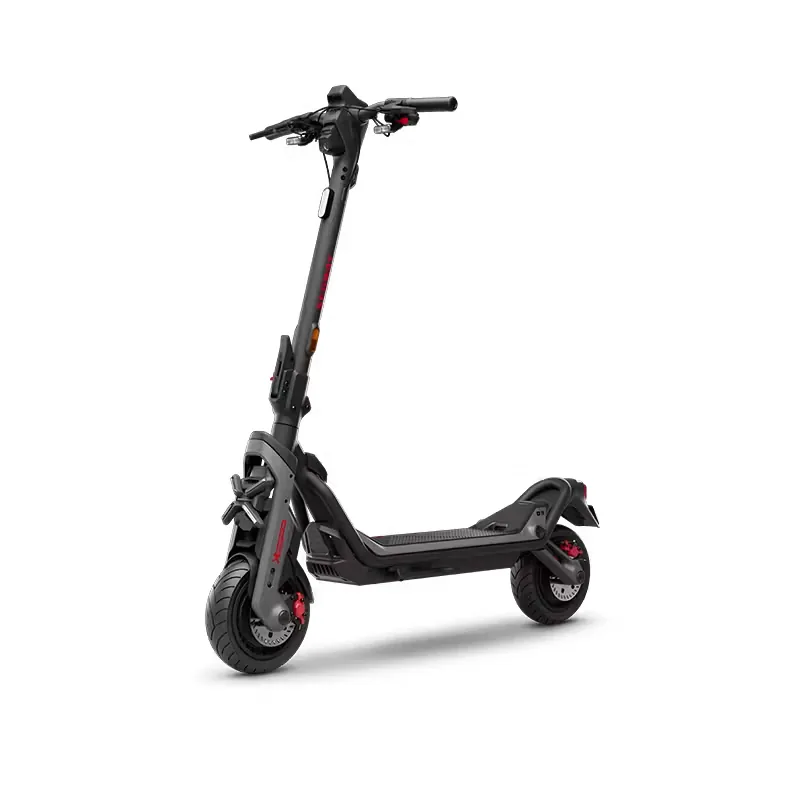
Segway Ninebot
Segway GT3
No citable customer rating — see how we compare.
36 mi estimated · 45 mi claimed · 33.5 mi tested
The claim is 1.3× the estimate. How this is worked out.
The GT3 replaced the GT1 and lost 18 pounds and 6 mph doing it, which sounds like a downgrade and mostly is not. Hydraulic discs at both ends, 899 Wh, IPX6, NFC unlock and a genuinely stiff chassis make it the most road-focused scooter Segway builds that a normal person can still fold and load into a car. It also posts one of the best claim-to-tested ratios in this catalog: 33.5 miles measured against 45 claimed. The compromises are physical. Eighty-seven pounds is past the point where any folding mechanism helps, the handlebars do not fold at all, and there is no regenerative braking to recover anything on a descent. Owners cross-shopping it against the Max G3 mostly land on the same conclusion — the GT3 is the better machine and the G3 is the one that fits in the boot of a small car. Pick on whether you will actually be lifting it.
- Approx. price
- ~$1,699
- Estimated range
- 36 mi
- Claimed range
- 45 mi
- Top speed
- 31 mph
- Weight
- 87.1 lb
- Weight class
- Rolls only
Best for: A fast road commute you never have to carry
Specifications
- Estimated range
- 36 mi
- Claimed range
- 45 mi (1.3x the estimate)
- Tested range
- 33.5 mi
- Top speed
- 31 mph
- Motor
- Single motor, 1,200 W (2,400 W peak)
- Battery
- 899 Wh at 46.8 V
- Wh per dollar
- 0.53 Wh/$
- Wh per pound
- 10 Wh/lb
- Weight
- 87.1 lb — rolls only
- Max rider weight
- 330 lb
- Rated grade
- 30%
- Tires
- 11" self-healing
- Suspension
- Dual
- Brakes
- Dual hydraulic disc
- IP rating
- IPX6
- Charge time
- 5.5 h
- Folded size
- 54.1 x 25 x 23 in
- Deck width
- 7.9 in
- Lights
- Headlight, taillight, turn signals
- App
- Yes
- Cruise control
- Yes
- Approx. price
- ~$1,699
- Released
- 2025
55 lb and up — this goes where it can be wheeled, and lives at ground level. Estimated range is our own calculation from the battery capacity; the claim is the manufacturer’s.
Features
- Dual hydraulic disc brakes
- 899 Wh pack at 46.8 V
- 11-inch self-healing tubeless tires
- Dual suspension
- NFC unlock and app
- Turn signals and brake light
- IPX6 water resistance
- 330 lb rider capacity
In its favour
- Tested 33.5 miles against a 45-mile claim — among the most honest ratios here
- Hydraulic discs at both ends, a real upgrade over the mechanical discs on the Max line
- 330 lb rider limit and a stiff chassis suit heavier riders
- IPX6 and self-healing tires make it a genuine all-weather machine
- Lighter and cheaper than the GT1 it replaces
- NFC unlock means no phone dance before a ride
Against it
- 87 lb, and the handlebars do not fold
- No regenerative braking, so nothing is recovered on long descents
- Top speed dropped 6 mph versus the GT1
- Needs a car with a flat boot floor or somewhere at ground level to live
The lists above combine the specification sheet with what owners of this model report.
What owners say
Summarised from owner discussions and long-term owner write-ups.
The GT3 replaced the GT1 and did something unusual: it got lighter, cheaper and slower. Owners who have ridden both mostly regard that as the right trade. Hydraulic discs at both ends, 899 watt-hours and a chassis that is genuinely planted at 30 mph make it the most road-focused machine Segway builds that an ordinary person can still fold into a car — and the 33.5-mile tested range against a 45-mile claim is one of the more honest ratios in this catalog.
The physical realities are what decide it. Eighty-seven pounds is past the point where any folding mechanism helps, the handlebars do not fold at all, and there is no regeneration to recover anything on a descent. Riders cross-shopping it against the Max G3 mostly conclude the GT3 is the better machine and the G3 is the one that fits in a small car boot.
What owners like
- Tested 33.5 miles against a 45-mile claim — owners weighing it against the Max G3 keep landing on the range as the deciding factor
- Hydraulic discs at both ends, which is the specification the Max line does not offer at any price
- Owners describe it as rock-solid at speed, with none of the vagueness lighter scooters show at 30 mph
- Lighter and cheaper than the GT1 it replaced, which surprised owners expecting the usual generational price rise
- NFC unlock means no phone unlock ritual before every ride
Common complaints
- The handlebars do not fold at all, which owners discover when they try to put it in a car
- 87 lb, and the fold does not help much — this is a scooter that lives at ground level
- No regenerative braking, so nothing is recovered on a long descent and the pads do all the work
- Top speed dropped 6 mph versus the GT1, which owners of the older model consider a downgrade
Questions people ask
Can I fit a GT3 in a car?
Is the loss of 6 mph from the GT1 a problem?
Does it need regenerative braking?
Head to head
Also worth a look
Segway Ninebot
Segway Ninebot Max G3
23.9 mi est · 54.2 lb · ~$1,199
Segway Ninebot
Segway Ninebot ZT3 Pro
23.9 mi est · 65.5 lb · ~$869
Segway Ninebot
Segway Ninebot Max G2
22 mi est · 53.5 lb · ~$799