Apollo
Apollo Explore 2.0
No citable customer rating — see how we compare.
25.9 mi estimated · 37 mi claimed
The claim is 1.4× the estimate. How this is worked out.
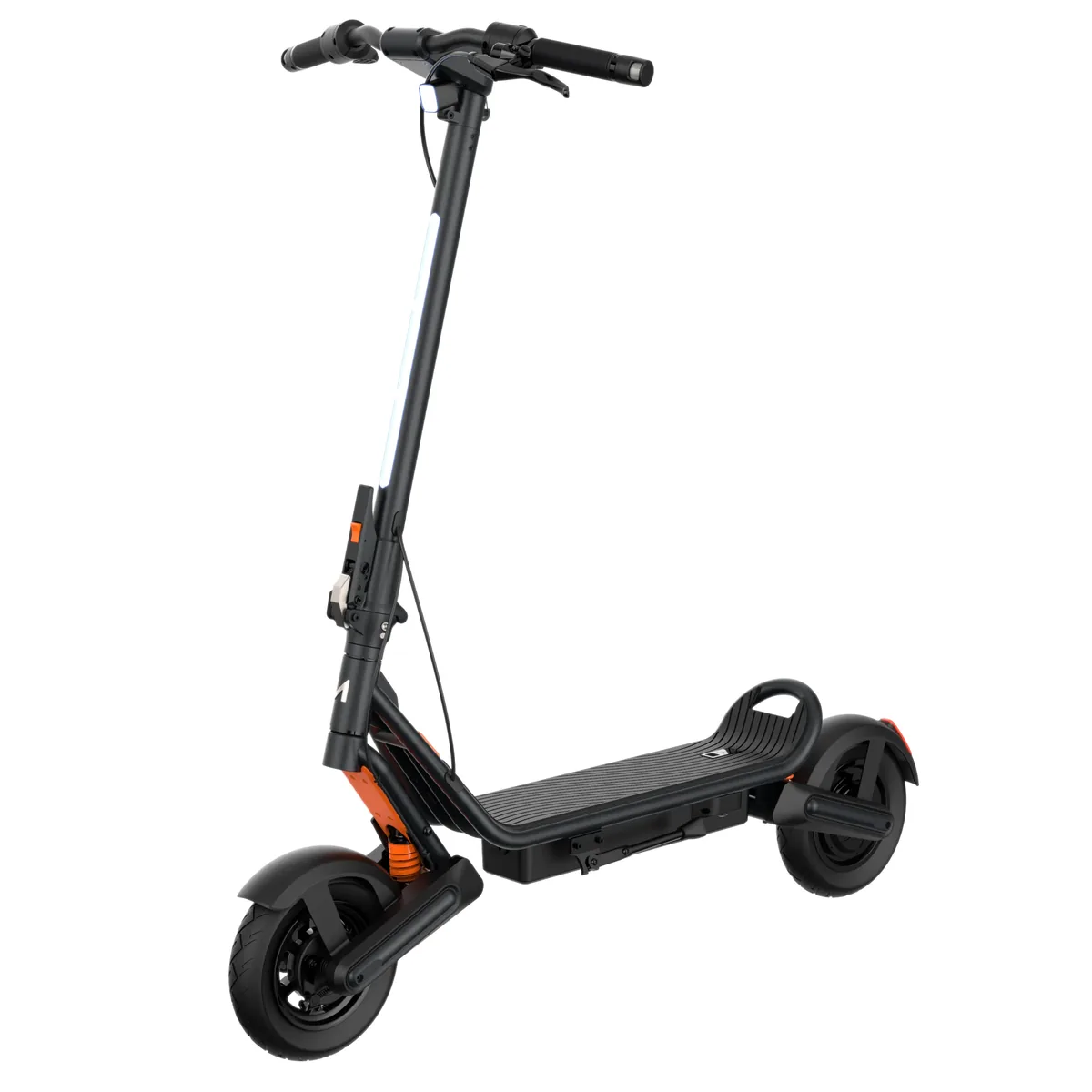
Triple-spring suspension, six inches of ground clearance, 21700 cells and IP66 sealing make the Explore 2.0 the most rugged single-motor scooter Apollo sells, and the 648 Wh pack with regenerative recovery gives it a genuine long-commute range. It is also the model with the most serious failure history in this catalog. One owner documented the pin holding the handlebars in position snapping in half, while riding, on two separate Explore frames; Apollo's response was a discount on a replacement rather than a repair, because the parts were no longer stocked. Other owners report frequent inner-tube punctures and brake discs going out of alignment weekly. Apollo has revised the platform since, and the current version ships with self-healing tubeless tires that address the puncture complaint directly. Buy it with the stem hardware on an inspection schedule and the extended warranty in the basket.
- Approx. price
- ~$799
- Estimated range
- 25.9 mi
- Claimed range
- 37 mi
- Top speed
- 25 mph
- Weight
- 60 lb
- Weight class
- Rolls only
Best for: Rough roads and kerbs on a single-motor budget
Specifications
- Estimated range
- 25.9 mi
- Claimed range
- 37 mi (1.4x the estimate)
- Top speed
- 25 mph
- Motor
- Single motor, 800 W (1,650 W peak)
- Battery
- 648 Wh at 48 V
- Wh per dollar
- 0.81 Wh/$
- Wh per pound
- 11 Wh/lb
- Weight
- 60 lb — rolls only
- Max rider weight
- 265 lb
- Rated grade
- 27%
- Tires
- 10" self-healing
- Suspension
- Dual
- Brakes
- Front drum with regenerative rear
- IP rating
- IP66
- Charge time
- 8 h
- Folded size
- 50 x 26.6 x 22 in
- Lights
- Headlight, taillight
- App
- Yes
- Cruise control
- Yes
- Approx. price
- ~$799
- Released
- 2025
55 lb and up — this goes where it can be wheeled, and lives at ground level. Estimated range is our own calculation from the battery capacity; the claim is the manufacturer’s.
Features
- 1,650 W peak motor
- 648 Wh pack with 21700 cells
- Triple spring suspension
- 10-inch self-healing tubeless tires
- Six inches of ground clearance
- IP66 water resistance
- Regenerative braking that recovers up to 10% range
- Apollo app
In its favour
- Six inches of ground clearance and triple spring suspension
- 648 Wh with regenerative recovery gives a real long-commute range
- IP66 sealing on a sub-$800 scooter
- Current version ships tubeless and self-healing, which fixes the older model's puncture complaint
- 21700 cells rather than the older 18650 format
Against it
- Earlier frames produced documented handlebar-pin failures in motion, twice on the same owner
- Owners report brake discs needing realignment roughly weekly
- Front drum with rear regen is light for a 60-pound scooter
- Apollo stopped stocking parts for the previous generation, which is a warranty risk worth pricing in
- Eight-hour charge
The lists above combine the specification sheet with what owners of this model report.
What owners say
Summarised from owner discussions and long-term owner write-ups.
The Explore is the rugged one in Apollo's single-motor range: triple spring suspension, six inches of ground clearance, 21700 cells and IP66 sealing, which on paper is a lot of scooter for under $800. Owners riding it on rough ground like it for exactly those reasons, and the current tubeless self-healing tires fix the most common complaint about the previous version.
It is also the model with the most serious failure history in this catalog. One owner published a detailed account of the pin retaining the handlebars snapping in half, while the scooter was moving — and then of the same failure happening on the replacement frame. Apollo offered a discount on a new scooter rather than a repair, because it no longer stocked one of the two parts needed. That is a specific, documented, structural problem with a specific support outcome, and anyone buying one should read it before deciding rather than after.
What owners like
- Six inches of ground clearance and triple spring suspension make it the most rugged single-motor scooter Apollo sells
- IP66 sealing on a sub-$800 scooter, which nothing else at the price offers
- The current version ships with self-healing tubeless tires, which directly addresses the puncture complaints on the older model
- 648 Wh with regenerative recovery gives it a genuine long-commute range
- 21700 cells rather than the older 18650 format, which owners with a technical bent treat as a real signal
Common complaints
- An owner documented the pin holding the handlebars in position snapping in half while riding — on two separate Explore frames
- Apollo's response to that failure was a discount on a new scooter, because the parts to repair the existing one were no longer stocked
- Owners on the older tubed version report punctures constantly, and brake discs going out of alignment roughly weekly
- A front drum with rear regeneration is light braking for a 60-pound scooter
- 60 lb without suspension-adjusted geometry makes it awkward to lift
Questions people ask
What exactly failed on the older Explore?
Have the punctures been fixed?
Is the braking adequate?
Is the extended warranty worth buying?
Head to head
Also worth a look
NIU
NIU KQi3 Max
24.3 mi est · 46.3 lb · ~$799
NIU
NIU KQi 300X
24.3 mi est · 48.7 lb · ~$799
NAVEE
NAVEE ST3 Pro
23.9 mi est · 55 lb · ~$800