Apollo
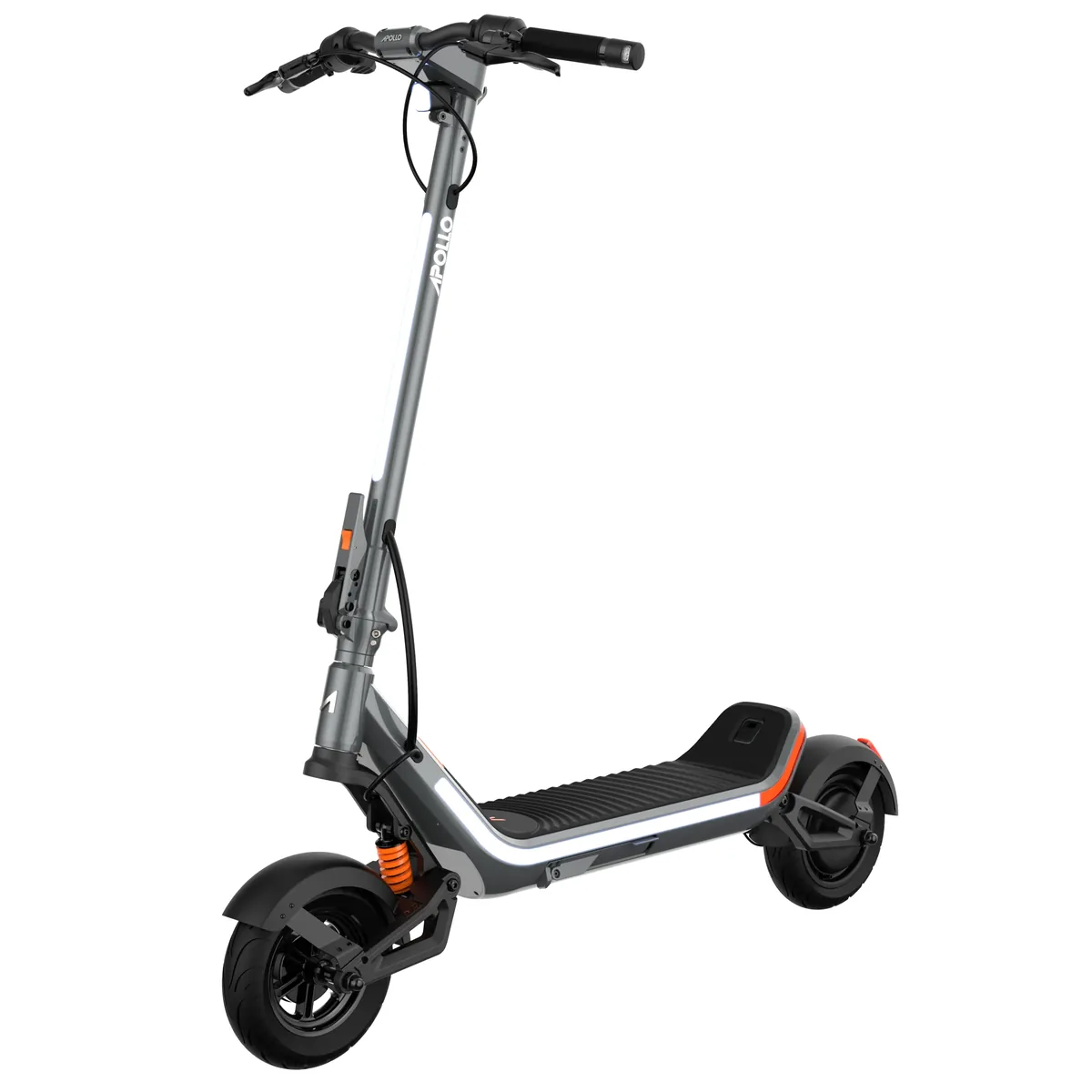
Apollo City 2.0
No citable customer rating — see how we compare.
25.3 mi estimated · 38 mi claimed · 29.8 mi tested
The claim is 1.5× the estimate. How this is worked out.
The City is the scooter Apollo is known for, and the combination it offers — 32 mph, 960 watt-hours, IP66 sealing, a 4.5-hour charge and a tested 29.8 miles — is genuinely hard to match at the price. A rider who put a thousand kilometres on the previous generation in the rainy Pacific Northwest, commuting year-round, reported the drivetrain handling it without complaint. The complaints from that same report are instructive about where the money did not go: a kickstand too flimsy to hold the scooter facing downhill, a carrying latch that works loose, and no Bluetooth or power-on while charging, so you cannot check the battery from the app mid-charge. More seriously, earlier City generations produced multiple accounts of the handlebar assembly failing at the hinge in motion. Apollo has revised the design since, but inspect the stem hardware regularly and do not defer it.
- Approx. price
- ~$1,399
- Estimated range
- 25.3 mi
- Claimed range
- 38 mi
- Top speed
- 32 mph
- Weight
- 65 lb
- Weight class
- Rolls only
Best for: All-weather commuting at real road speeds
Specifications
- Estimated range
- 25.3 mi
- Claimed range
- 38 mi (1.5x the estimate)
- Tested range
- 29.8 mi
- Top speed
- 32 mph
- Motor
- Dual motor, 1,000 W (2,000 W peak)
- Battery
- 960 Wh at 48 V
- Wh per dollar
- 0.69 Wh/$
- Wh per pound
- 15 Wh/lb
- Weight
- 65 lb — rolls only
- Max rider weight
- 265 lb
- Tires
- 10" self-healing
- Suspension
- Dual
- Brakes
- Front mechanical disc with regen
- IP rating
- IP66
- Charge time
- 4.5 h
- Folded size
- 48 x 26.6 x 22 in
- Deck width
- 7.5 in
- Lights
- Headlight, taillight, turn signals
- App
- Yes
- Cruise control
- Yes
- Approx. price
- ~$1,399
- Released
- 2025
55 lb and up — this goes where it can be wheeled, and lives at ground level. Estimated range is our own calculation from the battery capacity; the claim is the manufacturer’s.
Features
- Dual hub motors, 2,000 W peak
- 960 Wh pack, 4.5-hour charge
- IP66 water resistance
- 10-inch self-healing tubeless tires
- Dual spring suspension
- Turn signals
- Apollo app with 80+ settings
- Apple Find My compatible
In its favour
- Tested 29.8 miles at 32 mph capability — among the best range-per-speed here
- 4.5-hour charge on a 960 Wh pack is exceptional
- IP66 sealing has survived year-round wet commuting in owner reports
- Dual suspension and self-healing tires
- Turn signals front and rear
- Apple Find My support, which is worth having on a scooter this desirable
Against it
- Earlier generations produced multiple reports of the handlebar assembly failing at the hinge in motion
- Front disc plus regen only — no rear mechanical brake on a 32 mph scooter
- Owners report a flimsy kickstand and a carry latch that works loose
- Cannot power on or use Bluetooth while charging
- 65 lb
The lists above combine the specification sheet with what owners of this model report.
What owners say
Summarised from owner discussions and long-term owner write-ups.
The City is the scooter Apollo is known for and the reason is that the package is genuinely hard to match: 32 mph, 960 watt-hours, IP66 sealing and a four-and-a-half-hour charge. An owner who put a thousand kilometres on the previous generation commuting year-round in the rainy North-West reported the drivetrain handling all of it without complaint, which is the strongest kind of endorsement this category produces.
The same owner's list of complaints is instructive about where the money did not go: a kickstand that will not hold the scooter on a slope, a carrying latch that works loose, and no way to check the battery from the app while it charges. More seriously, earlier City generations produced several first-hand accounts of the handlebar assembly failing at the hinge in motion — one rider described the bars snapping off above the hinge with no warning at all. Apollo has revised the design, but the stem hardware belongs on an inspection schedule and the brand's support record is the risk you are accepting alongside the scooter.
What owners like
- A thousand kilometres of year-round commuting in the rainy North-West, on cycle paths and over bridges, with no drivetrain trouble reported
- The IP66 sealing is the reason owners in wet climates choose Apollo over better-known brands
- Owners describe it as the best-looking scooter they have owned, which matters more to buyers than spec sheets admit
- Tested 29.8 miles at a scooter capable of 32 mph — one of the best range-per-speed figures here
- A 4.5-hour charge on a 960 Wh pack is exceptional and owners notice it daily
- The Apollo app exposes more adjustment than almost any rival's, down to individual brake and acceleration curves
Common complaints
- Earlier City generations produced accounts of the handlebar assembly snapping off above the hinge while riding, with no warning
- Owners report a kickstand too flimsy to hold the scooter facing downhill
- The latch on the riding platform used to carry the scooter works loose over time
- You cannot power the scooter on or use Bluetooth while it is charging, so there is no way to check the battery mid-charge
- Apollo's support and repair-centre record is the single most criticised thing about the brand, across several models
Questions people ask
Is the stem failure still a risk?
How bad is Apollo's customer support?
Is IP66 enough for a wet commute?
Only one mechanical brake at 32 mph?
Head to head
Also worth a look
Apollo
Apollo Go Stellar
14.2 mi est · 46 lb · ~$1,199
Apollo
Apollo Explore 2.0
25.9 mi est · 60 lb · ~$799
NAVEE
NAVEE NT5 Ultra X
23.7 mi est · 80.5 lb · ~$1,300