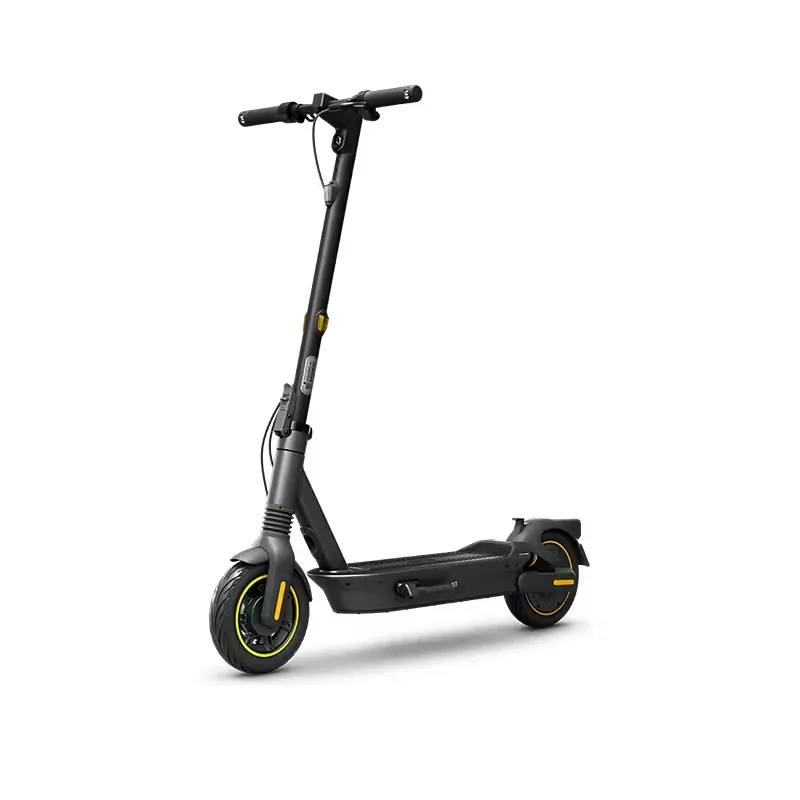
Segway Ninebot
Segway Ninebot Max G2
No citable customer rating — see how we compare.
22 mi estimated · 43 mi claimed · 29.8 mi tested
The claim is 2× the estimate. How this is worked out.
For two years the Max G2 was the default answer to "what commuter should I buy", and it earned that on ride quality rather than numbers. The front hydraulic fork and adjustable rear spring are a genuine suspension system, not rubber pucks, and owners describe the ride as the smoothest thing in its price bracket — one posted a thousand kilometres with nothing to report but how comfortable it was. Independent testing backs the battery too: 29.8 miles in regular riding is one of the better real-world showings in this catalog, even if it is a long way from the 43 on the box, and a rider in hilly terrain at 85 kg reported closer to fifteen. The unavoidable flaw is the braking. There is a front drum and there is regenerative braking, and that is the whole system — no mechanical rear brake at all. On a 53-pound scooter carrying a rider at 22 mph, that is a deliberate cost decision you feel every time the pack runs low and the regen softens.
- Approx. price
- ~$799
- Estimated range
- 22 mi
- Claimed range
- 43 mi
- Top speed
- 22 mph
- Weight
- 53.5 lb
- Weight class
- Curb lift
Best for: A long daily commute where comfort matters more than speed
Specifications
- Estimated range
- 22 mi
- Claimed range
- 43 mi (2x the estimate)
- Tested range
- 29.8 mi
- Top speed
- 22 mph
- Motor
- Single motor, 450 W (1,000 W peak)
- Battery
- 551 Wh at 36 V
- Wh per dollar
- 0.69 Wh/$
- Wh per pound
- 10 Wh/lb
- Weight
- 53.5 lb — curb lift
- Max rider weight
- 265 lb
- Rated grade
- 20%
- Tires
- 10" self-healing
- Suspension
- Dual
- Brakes
- Front drum with regenerative rear
- IP rating
- IPX5
- Charge time
- 6 h
- Folded size
- 46.9 x 21.3 x 23.6 in
- Deck width
- 6.7 in
- Lights
- Headlight, taillight, turn signals
- App
- Yes
- Cruise control
- Yes
- Approx. price
- ~$799
- Released
- 2023
35-55 lb — you can lift it into a boot or over a kerb, not carry it far. Estimated range is our own calculation from the battery capacity; the claim is the manufacturer’s.
Features
- Front hydraulic fork with adjustable rear spring
- 10-inch self-healing tubeless tires
- Turn signals and brake light
- Traction control
- Apple Find My
- Cruise control and speed modes
- IPX5 water resistance
In its favour
- Tested 29.8 miles in mixed riding — one of the strongest real-world showings here
- Owners consistently single out ride quality as the smoothest at this price
- Front hydraulic fork and adjustable rear spring, not rubber dampers
- Self-healing tubeless tires and IPX5 make winter and wet commuting practical
- The most common scooter in the category, so parts and second-hand spares are everywhere
- Traction control is fitted as standard, which matters on wet painted road markings
Against it
- No mechanical rear brake — front drum plus regen is the entire system
- 53.5 lb makes it a scooter you roll, not one you carry up stairs
- Riders over about 180 lb in hilly terrain report roughly half the claimed range
- Six-hour charge without the optional fast charger
- Superseded by the Max G3, so discounting is erratic
The lists above combine the specification sheet with what owners of this model report.
What owners say
Summarised from owner discussions and long-term owner write-ups.
For two years the Max G2 was the default recommendation in this category, and the reason was never the spec sheet. It was that the front hydraulic fork and adjustable rear spring produce a ride nothing else at the price matches, and that the thing simply keeps working: owner reports at a thousand kilometres and beyond consistently describe zero issues. Independent testing backs the battery up at 29.8 real miles.
The complaint that never goes away is the braking. There is one mechanical brake, at the front, and regeneration at the rear — on a 53-pound scooter carrying a rider at 22 mph. Owners who ride hills notice it, and riders who have moved to something with discs at both wheels describe the difference as large. The other consistent note is range in the real world: a heavier rider on hills sees a fraction of the claim, which is normal for the category but a long way from 43 miles.
What owners like
- Ride quality is the thing owners mention first and most — the hydraulic front fork and adjustable rear spring make it the smoothest scooter in its price bracket
- One owner posted a thousand kilometres with nothing to report but how comfortable it was, which is unusual in a category full of failure threads
- Traction control is fitted as standard and owners in wet cities notice it on painted road markings
- Self-healing tires have made punctures a non-topic for this model
- It is common enough that spares, second-hand parts and people who have fixed one are easy to find
- Independent testing measured 29.8 miles, which is genuinely usable and among the better real-world figures here
Common complaints
- There is no mechanical rear brake at all — a front drum and regeneration is the whole system, and it is the most-criticised thing about the scooter
- A rider at 85 kg in hilly terrain reported 24 km of total range against a 43-mile claim
- 53.5 lb puts it firmly in the roll-only class, whatever the folding mechanism suggests
- Owners report wrist fatigue on long rides, which the suspension mitigates rather than solves
- Riding it where local law does not permit a scooter has cost owners the scooter — one had a Max G2 impounded as an unregistered motor vehicle
Questions people ask
Is the missing rear brake actually a problem?
What range should I actually plan for?
Max G2 or Max G3?
Can I ride it in the rain?
Is it legal where I live?
Head to head
Also worth a look
Segway Ninebot
Segway Ninebot ZT3 Pro
23.9 mi est · 65.5 lb · ~$869
Segway Ninebot
Segway Ninebot F3
19.1 mi est · 41 lb · ~$700
Segway Ninebot
Segway Ninebot Max G3
23.9 mi est · 54.2 lb · ~$1,199