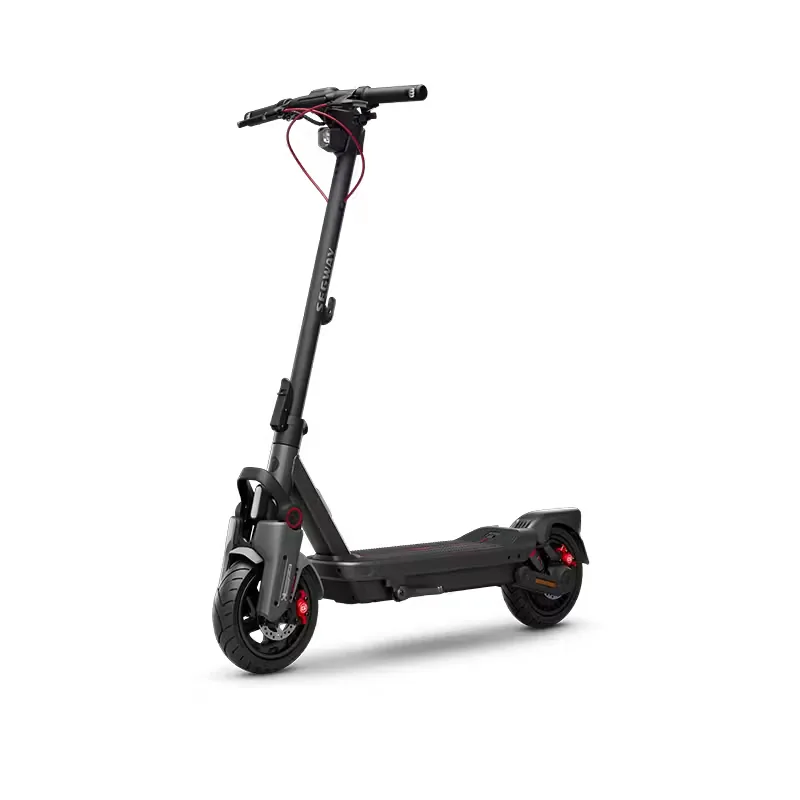
Segway Ninebot / Long-range commuter
Segway Ninebot Max G3
No citable customer rating — see how we compare.
23.9 mi estimated · 50 mi claimed · 24.9 mi tested
The claim is 2.1× the estimate. How this is worked out.
The Max G3 is where Segway stopped conceding the spec sheet. Peak output doubled to 2,000 watts, the voltage moved to 46.8 V, both ends got adjustable hydraulic suspension, the brakes finally became two mechanical discs, and the charge time dropped to three and a half hours. It is the same 54-pound footprint as the G2 with meaningfully more scooter inside it. Owners are direct about the range, though, and the arithmetic agrees with them: a 597 Wh pack pushed to 28 mph gives about fourteen miles in sport mode, against a 50-mile claim measured somewhere much slower. Independent testing came in at 24.9 miles in regular riding. Plan a commute around the tested number, not the box. Ride quality and hill pace, on the other hand, draw no complaints at all.
- Price
- ~$999
- Estimated range
- 23.9 mi
- Claimed
- 50 mi
- Top speed
- 28 mph
- Weight
- 53.6 lb
- Carry
- Curb lift
We may earn a commission. Price and stock on Amazon’s site may differ from ours.
Best for: A hilly commute where 28 mph and real brakes are worth the weight
Specifications
- Estimated range
- 23.9 mi
- Claimed range
- 50 mi (2.1x the estimate)
- Tested range
- 24.9 mi
- Top speed
- 28 mph
- Motor
- Single motor, 850 W (2,000 W peak)
- Battery
- 597 Wh at 46.8 V
- Wh per dollar
- 0.6 Wh/$
- Wh per pound
- 11 Wh/lb
- Weight
- 53.6 lb — curb lift
- Max rider weight
- 286 lb
- Rated grade
- 30%
- Tires
- 11" tubeless
- Suspension
- Dual
- Brakes
- Dual mechanical disc with regen
- IP rating
- IPX6
- Charge time
- 3.5 h
- Folded size
- 48 x 23.2 x 23.3 in
- Deck width
- 7.9 in
- Lights
- Headlight, taillight, turn signals
- App
- Yes
- Cruise control
- Yes
- Approx. price
- ~$999
- Released
- 2025
35-55 lb — you can lift it into a boot or over a kerb, not carry it far. Estimated range is our own calculation from the battery capacity; the claim is the manufacturer’s.
Features
- Adjustable hydraulic suspension front and rear
- 11-inch tubeless tires
- Dual mechanical disc brakes with regen
- 3.5-hour charge
- TFT display, turn signals, electronic horn
- Apple Find My and PIN unlock
- Adjustable brake curve and acceleration
- IPX6 water resistance
In its favour
- Adjustable hydraulic suspension at both ends — a genuine step up from the G2's spring rear
- Dual mechanical discs finally replace the front-drum-and-regen setup
- 3.5-hour charge is among the fastest in the commuter class
- 286 lb rider limit, the highest of Segway's Ninebot commuters
- Owners report it clears steep climbs without dropping much speed
- The app caps speed and acceleration per rider, which makes lending it less alarming
Against it
- Owners report about 14 miles in sport mode against a 50-mile claim
- 53.6 lb is a two-hand lift, not a carry
- Priced at the point where dual-motor performance scooters start
- Ships limited to 20 mph; the 28 mph mode is unlocked in Segway's app
The lists above combine the specification sheet with what owners of this model report.
What owners say
Summarised from owner discussions and long-term owner write-ups.
The Max G3 is the generation where Segway stopped losing the spec-sheet argument. Peak output doubled, both ends got adjustable hydraulic suspension, the brakes became two mechanical discs, and the charge time fell to three and a half hours. Owners riding one report it climbing anything and riding beautifully, and the build quality complaints that dog cheaper scooters are absent.
One thing is worth knowing before you buy. The range is nothing like the claim: an owner riding in sport mode at 25 mph and above measured 14.2 miles, against 50 on the box, and independent testing put regular riding at 24.9.
What owners like
- Ride quality and build draw no complaints at all — the adjustable hydraulic suspension at both ends is the clearest upgrade over the G2
- Owners report it clearing every hill they have thrown at it without dropping much speed
- A 160 lb owner reported carrying it up to a third-floor apartment, which is at the limit of what 54 pounds allows but is manageable
- A three-and-a-half-hour charge changes what a daily commute looks like compared with the G2's six
- Owners consistently describe the specification as the point at which Segway stopped conceding the spec sheet to cheaper rivals
Common complaints
- One owner measured 14.2 miles in sport mode at 25 mph-plus against a 50-mile claim — plan around the sport-mode number
- It ships limited to 20 mph; the 28 mph mode has to be unlocked in Segway's app
- 53.6 lb is a two-handed lift, and the fold does not make it a scooter you carry casually
- It arrived at a price where dual-motor performance scooters start, which makes the value argument closer than the spec sheet suggests
Questions people ask
How far does it actually go?
Can one person carry it upstairs?
Max G3 or the GT3?
Head to head
Also worth a look
Segway Ninebot
Segway Ninebot Max G30P
22 mi est · 41.2 lb · ~$1,000
Segway Ninebot
Segway Ninebot ZT3 Pro
23.9 mi est · 65.5 lb · ~$869
Segway Ninebot
Segway Ninebot Max G2
22 mi est · 53.5 lb · ~$799