Segway Ninebot
Segway Ninebot ZT3 Pro
No citable customer rating — see how we compare.
23.9 mi estimated · 43.5 mi claimed · 22.7 mi tested
The claim is 1.8× the estimate. How this is worked out.
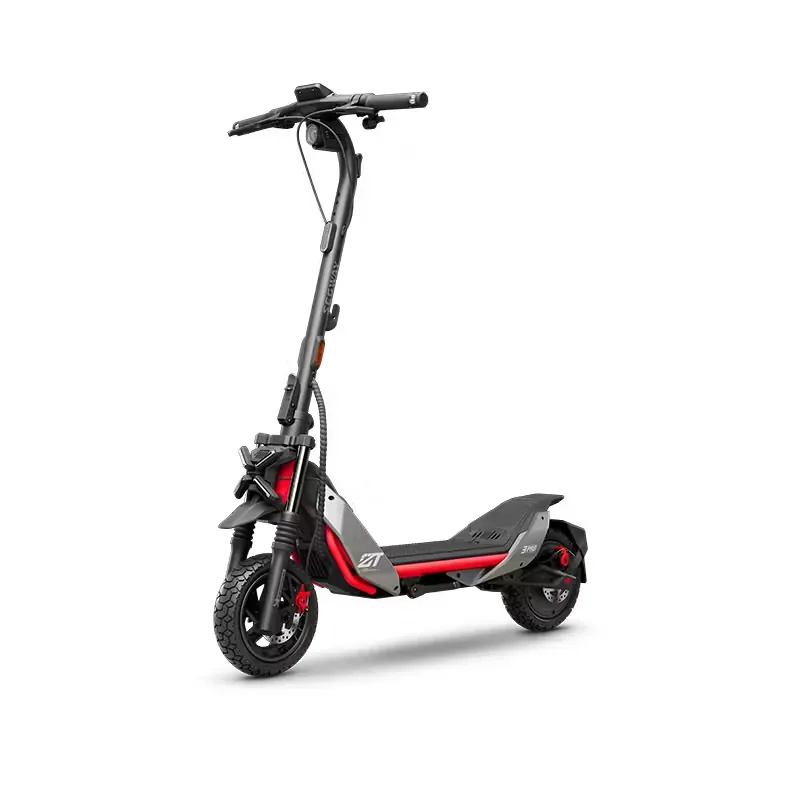
Segway's off-road-flavoured commuter: 11-inch tires, dual spring suspension, a wide deck and a 31% rated slope, wrapped around the same 597 Wh pack as the Max G3 but with a smaller motor and fifteen extra pounds. On gravel paths and broken kerbs it is genuinely more capable than a Max, and one owner posting after 627 km reported no faults at all. The problem is what launched next to it. The Max G3 arrived at a similar price with double the peak power, a faster charge and better brakes, and owners noticed immediately — the ZT3 Pro now reads as the more expensive, slower option unless you specifically want the wider stance. The brakes are the other soft spot: the rear setup is weak enough that a visible minority of owners replace the rotor with a larger aftermarket disc as their first modification. Tested range is 22.7 miles against the 43.5 claimed, roughly the 52% that the category's worst offenders deliver.
- Approx. price
- ~$869
- Estimated range
- 23.9 mi
- Claimed range
- 43.5 mi
- Top speed
- 24.9 mph
- Weight
- 65.5 lb
- Weight class
- Rolls only
Best for: Gravel paths and broken kerbs on a commute that doesn't involve stairs
Specifications
- Estimated range
- 23.9 mi
- Claimed range
- 43.5 mi (1.8x the estimate)
- Tested range
- 22.7 mi
- Top speed
- 24.9 mph
- Motor
- Single motor, 650 W (1,600 W peak)
- Battery
- 597 Wh at 46.8 V
- Wh per dollar
- 0.69 Wh/$
- Wh per pound
- 9 Wh/lb
- Weight
- 65.5 lb — rolls only
- Max rider weight
- 265 lb
- Rated grade
- 31%
- Tires
- 11" tubeless
- Suspension
- Dual
- Brakes
- Dual mechanical disc with regen
- IP rating
- IPX5
- Charge time
- 6 h
- Folded size
- 49 x 25.1 x 23 in
- Lights
- Headlight, taillight, turn signals
- App
- Yes
- Cruise control
- Yes
- Approx. price
- ~$869
- Released
- 2024
55 lb and up — this goes where it can be wheeled, and lives at ground level. Estimated range is our own calculation from the battery capacity; the claim is the manufacturer’s.
Features
- 11-inch tubeless tires with dual spring suspension
- Wide off-road deck
- Dual mechanical disc brakes with regen
- Turn signals
- Apple Find My and walk mode
- Adjustable acceleration and brake curves
- IPX5 water resistance
In its favour
- 11-inch tires and a wide deck make rough surfaces a non-event
- 31% rated slope is strong for a single-motor scooter
- Owners report several hundred kilometres with no faults
- Find My tracking and walk mode are genuinely useful on a scooter this heavy
- Wide deck gives room to shift your feet on longer rides
Against it
- Owners replace the rear rotor with a larger aftermarket disc to get usable rear braking
- 65.5 lb — this is a roll-only scooter
- The newer Max G3 offers more power and a faster charge at a similar price
- Tested range is barely half the claim
The lists above combine the specification sheet with what owners of this model report.
What owners say
Summarised from owner discussions and long-term owner write-ups.
The ZT3 Pro is Segway's off-road-flavoured commuter and, taken on its own terms, it works: an owner at 627 kilometres reported nothing wrong with it at all, and the combination of 11-inch tires, dual spring suspension and a wide deck makes rough surfaces disappear. Riders upgrading from older Segway hardware pick out the tires and the suspension as the things that changed most.
Its problem is what launched next to it. Owners comparing it with the Max G3 — similar money, double the peak power, better brakes, faster charge — describe the ZT3 Pro as obsolete, and it is hard to argue. The brakes are the other soft spot: a visible minority of owners fit a larger aftermarket rear rotor, which is a telling first modification on a scooter that weighs 65 pounds.
What owners like
- An owner at 627 km reported no faults of any kind, which is a good record for a scooter with this much suspension travel
- The 11-inch tires and wide deck make broken pavement and gravel paths a non-event
- Find My and walk mode are genuinely useful on a scooter this heavy to manoeuvre
- Owners moving from an older Segway describe it as noticeably better on inclines and faster in a straight line
- Tires and suspension are the parts owners upgrading from an older P-series single out as the biggest improvement
Common complaints
- The rear brake is weak enough that owners replace the rotor with a larger aftermarket disc as their first modification
- At 65.5 lb it is heavier than the newer Max G3 while being slower and having a smaller motor
- Owners regard it as superseded — the Max G3 arrived with better specs at a similar price and the comparison is not kind
- Tested range of 22.7 miles against a 43.5-mile claim is one of the weaker ratios in this catalog
Questions people ask
Why do owners upgrade the rear brake?
Is it worth buying over a Max G3?
How rough a surface will it take?
Head to head
Also worth a look
Segway Ninebot
Segway Ninebot Max G2
22 mi est · 53.5 lb · ~$799
Segway Ninebot
Segway Ninebot F3
19.1 mi est · 41 lb · ~$700
Segway Ninebot
Segway Ninebot Max G3
23.9 mi est · 54.2 lb · ~$1,199