Segway Ninebot
Segway Ninebot F3
No citable customer rating — see how we compare.
19.1 mi estimated · 44 mi claimed
The claim is 2.3× the estimate. How this is worked out.
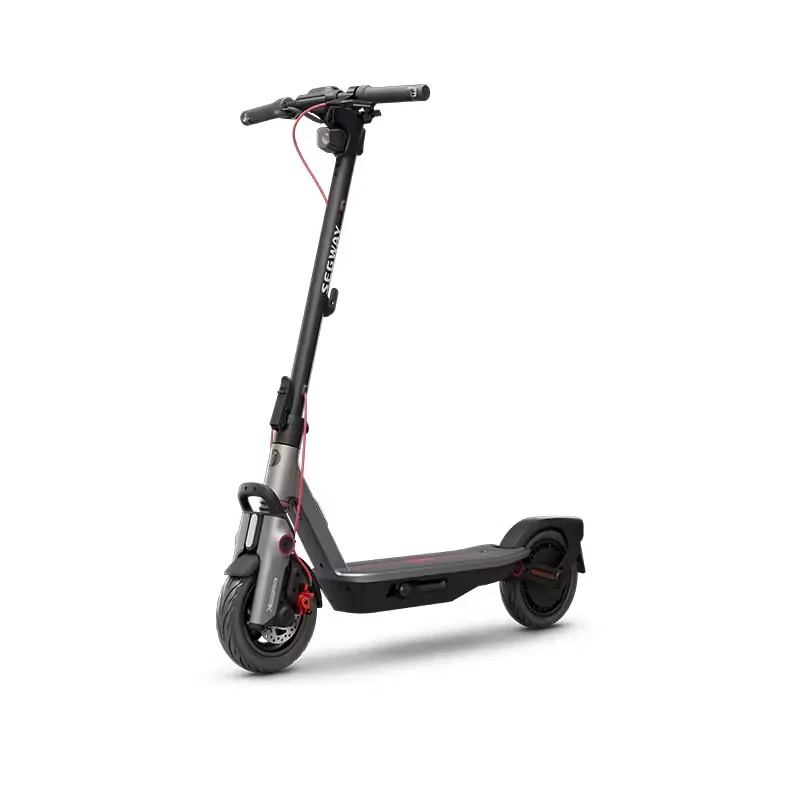
The F3 is the scooter that made a lot of Max G2 owners ask whether they had bought too early. It weighs twelve pounds less, brakes on two mechanical discs instead of a single front drum, carries an IPX6 rating and still folds into a hallway. Against that, the pack is smaller — 477 Wh against the G2's 551 — and the eight-hour charge is slow for a scooter people ride daily. The 44-mile claim is the figure to be most sceptical about here: divide the pack by a realistic 25 Wh per mile and you land near nineteen, which is what a rider at speed should actually plan around. Where the F3 earns its keep is as the lightest thing in Segway's range with real brakes at both ends and suspension at both ends, which is a combination that used to cost twice as much. If you carry the scooter more than you charge it, the F3 is the one in this lineup to look at first.
- Approx. price
- ~$700
- Estimated range
- 19.1 mi
- Claimed range
- 44 mi
- Top speed
- 20 mph
- Weight
- 41 lb
- Weight class
- Curb lift
Best for: Carrying up stairs without giving up brakes or suspension
Specifications
- Estimated range
- 19.1 mi
- Claimed range
- 44 mi (2.3x the estimate)
- Top speed
- 20 mph
- Motor
- Single motor, 450 W (1,000 W peak)
- Battery
- 477 Wh at 36 V
- Wh per dollar
- 0.68 Wh/$
- Wh per pound
- 12 Wh/lb
- Weight
- 41 lb — curb lift
- Max rider weight
- 265 lb
- Rated grade
- 22%
- Tires
- 10" self-healing
- Suspension
- Dual
- Brakes
- Dual mechanical disc with regen
- IP rating
- IPX6
- Charge time
- 8 h
- Folded size
- Folds
- Lights
- Headlight, taillight, turn signals
- App
- Yes
- Cruise control
- Yes
- Approx. price
- ~$700
- Released
- 2025
35-55 lb — you can lift it into a boot or over a kerb, not carry it far. Estimated range is our own calculation from the battery capacity; the claim is the manufacturer’s.
Features
- Dual mechanical disc brakes with regenerative assist
- Front hydraulic and rear rubber suspension
- 10-inch self-healing tubeless tires
- IPX6 water resistance
- Turn signals
- Cruise control and speed modes
- App with over-the-air updates
In its favour
- Mechanical discs front and rear, not the single front drum Segway usually fits at this price
- Twelve pounds lighter than the Max G2 with a similar feature set
- IPX6 is the highest water rating in Segway's commuter range
- Self-healing tires and suspension at both ends on a 41-pound frame
- Turn signals are standard, not an upsell
Against it
- 44-mile claim is more than double what 477 Wh realistically delivers
- Eight-hour charge is slow for a daily commuter
- Rear suspension is a rubber damper, not a spring or hydraulic unit
- Smaller pack than the Max G2 it is often cross-shopped against
The lists above combine the specification sheet with what owners of this model report.
What owners say
Summarised from owner discussions and long-term owner write-ups.
The F3 landed as the scooter that made recent Max G2 buyers uncomfortable. On paper it takes the same commuter brief and does it twelve pounds lighter, with mechanical discs at both wheels where the G2 has a front drum and regeneration, and with an IPX6 rating that the G2 does not match. Owners weighing the two against each other mostly conclude the F3 is the better machine unless you specifically want the bigger battery.
The caveats are the ones the spec sheet does not make obvious. The rear suspension is rubber rather than a spring, so the ride is firmer than a Max. The pack is smaller, which means the 44-mile claim is further from reality than the G2's 43. And eight hours on the charger is a real inconvenience for anyone commuting on it every day.
What owners like
- Owners cross-shopping it against a Max G2 keep reaching the same conclusion: twelve pounds lighter, better brakes, similar everything else
- Discs at both wheels instead of the Max G2's front drum and regen — the single most-cited reason to prefer it
- IPX6 is the highest water rating Segway fits to a commuter, and owners in wet climates buy it specifically for that
- Self-healing tires and suspension at both ends on a 41-pound scooter
- Launched at a price that undercut the Max G2 it sits beside, which owners noticed immediately
Common complaints
- The rear suspension is a rubber damper, not a spring — owners who expected a Max-grade ride were disappointed
- Smaller battery than the Max G2, so the real-world range is shorter despite the bigger claimed figure
- Eight hours to charge, which is long for a scooter people ride daily
- At 41 lb it is still not a scooter most people carry far, despite being marketed on its weight
Questions people ask
F3 or Max G2?
Will it really do 44 miles?
Is the rubber rear suspension worth anything?
Head to head
Also worth a look
Segway Ninebot
Segway Ninebot Max G2
22 mi est · 53.5 lb · ~$799
Segway Ninebot
Segway Ninebot ZT3 Pro
23.9 mi est · 65.5 lb · ~$869
Segway Ninebot
Segway Ninebot Max G3
23.9 mi est · 54.2 lb · ~$1,199